
The 2026 Workplace Strategy Playbook for UK Operations Directors
- Dec 12, 2025
- 3 min read
Updated: Jan 13
Introduction
This 2026 Workplace Strategy Playbook for UK Operations Directors outlines how SMEs can optimise cost, space, technology, experience, and compliance without overbuilding or overspending.
UK workplaces are entering a new era. After years of hybrid experimentation, rising occupancy costs, shifting employee expectations, and tightening sustainability regulations, 2026 is forcing Operations Directors to rethink how workplace performance is measured.
For companies with 50–200 employees across London and the UK, the question is now unavoidable:
How do you build a workplace that performs — operationally, financially, and experientially — without overspending or overbuilding?
This Playbook provides practical, operationally grounded strategies for 2026 across:
Cost
Space
Technology
Experience
Compliance
Measurement

Why 2026 Workplace Strategy Matters for UK Operations Directors
Four forces will define workplace strategy this year:
Hybrid stabilization – Mid-week peaks, low Mondays and Fridays.
London vacancy paradox – High vacancy and strong demand for prime space.
Cost inflation – FM, energy, and leases continue rising.
Sustainability pressure – MEES, energy audits, emissions rules.
Q: What is the biggest workplace challenge in 2026?
A: Balancing cost reduction with employee experience while meeting sustainability requirements.

Cost Strategy: The Efficiency-First Model
Most SMEs overpay for:
Empty desks
Unused rooms
Oversized leases
Inefficient HVAC and lighting
Outdated service contracts
Q: What’s the fastest way to reduce office costs in 2026?
A: Run a 30-day utilisation study and right-size your office space based on real attendance.
The C.O.S.T. Framework

C – Consolidate underused space. Room-by-room assessment reveals hidden waste.
O – Optimise using utilisation insights. Shift from static layouts to demand-led design.
S – Streamline leases and service contracts. Renegotiate cleaning, maintenance, and broadband based on actual usage.
T – Technology-led efficiencies. Use IoT sensors, predictive HVAC, and automation to reduce operational spend.
90-Day Cost Action Plan
Weeks 1–3: Collect utilisation + cost data
Weeks 4–6: Model consolidation scenarios
Weeks 7–12: Implement + recalibrate FM operations
Most SMEs see measurable cost improvements within 12 weeks.
For Operations Directors navigating hybrid work, rising costs, and regulation, this 2026 workplace strategy playbook offers a clear, actionable roadmap.
Space Strategy: Designing for Hybrid Permanence
UK companies frequently pay for twice the space they actually use.
Q: How much office space does a 100-person company need in 2026?
A: Typically 35–50 seats plus collaboration zones, depending on attendance patterns.
The U.L.T.R.A. Utilisation Blueprint

U – Usage Metrics. Track attendance, peaks, dwell time, and patterns.
L – Layout Optimization. Design zones around behaviour, not job titles.
T – Task-Based Zoning. Create spaces for deep work, collaboration, and social interaction.
R – Reservations & Hotelling. Move away from 1:1 desk allocation.
A – Amenity-Driven Collaboration. Use hospitality cues that encourage voluntary attendance.
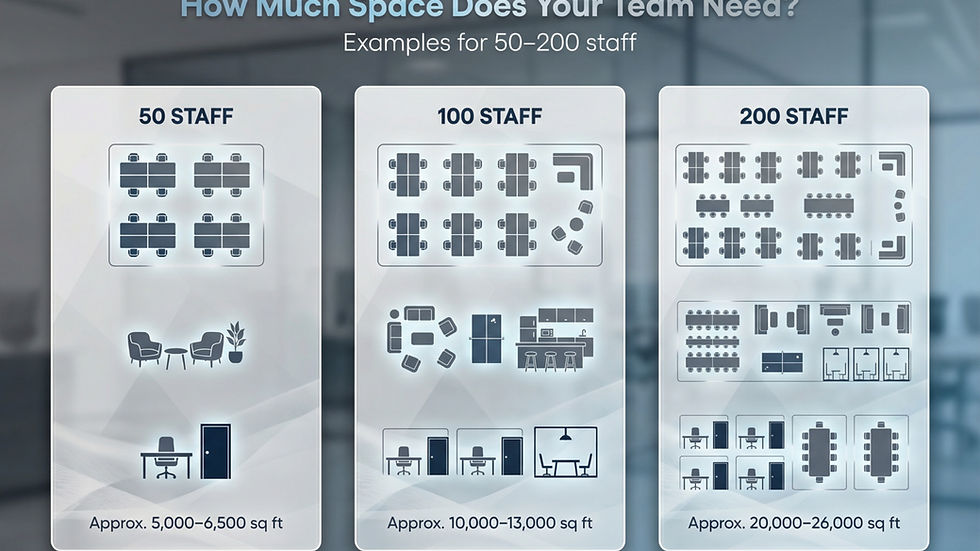
Space Scenarios for UK SMEs
50–80 staff: 20–30 seats, 3–4 multipurpose rooms
100–150 staff: 40–60 seats, 5–6 collaboration zones
150–200 staff: Hybrid HQ or hub-and-spoke often outperforms a single site
Technology Strategy: Smart Buildings for SMEs
Core components of the 2026 efficiency tech stack:
IoT occupancy sensors
AI-driven HVAC and automated lighting
Integrated building management systems
Digital booking and analytics tools
Q: What workplace technology delivers the best ROI in 2026?
A: Sensors + AI HVAC due to measurable energy savings.
The 1–2–3 Technology Roadmap

Install sensors
Analyse patterns
Automate HVAC + lighting
Experience Strategy: Create a Workplace People Want to Use

E – Engagement. Make the office feel intentional and socially valuable.
X – Experience Cues. Focus on lighting, acoustics, materials, and service touchpoints.
P – Performance Support. Ensure reliable meeting tech, ergonomic setups, and quality WiFi.
Compliance Strategy for UK SMEs
The Regulatory Landscape (2026–2030)
MEES
Energy reporting
Emissions frameworks
Building efficiency requirements
Q: What sustainability rules apply to UK offices in 2026?
A: MEES requirements, energy audits, emissions reporting, and building efficiency upgrades.

The 12-Week 2026 Workplace Playbook

Weeks 1–4 — Diagnose & Measure. Utilization, costs, experience, compliance baseline.
Weeks 5–8 — Redesign & Model. Layouts, cost scenarios, tech improvements.
Weeks 9–12 — Implement & Optimise. Reconfiguration, automation, engagement programmes.
KPI Dashboard for Operations Directors
Track:
Space utilisation
Cost per seat
Attendance patterns
Experience index
Energy consumption

Conclusion
The workplace is no longer a static cost centre — it is a strategic asset. Operations Directors who take an efficiency-first, experience-led, insight-driven approach will outperform the market in 2026. Smart decisions today shape the workplace your teams will want tomorrow.

For Operations Directors navigating hybrid work, rising costs, and regulation, this 2026 workplace playbook offers a clear, actionable roadmap.
Book a 20-Minute Workplace Strategy Diagnostic with Nativspace.
Download the extended 2026 Workplace Playbook


Comments